Buyer Intelligence disclosure: InteractiveKarting.com is operated with industry participation from HoloKart XR / Guangzhou Guwei. This guide is written to make system evaluation more transparent. It is not presented as an independent third-party ranking, and buyers should verify every supplier claim through demonstrations, documentation, references and contract terms.
Last reviewed: October 2026 · Audience: FEC owners, attraction developers, karting operators, consultants and procurement teams.
What is a complete interactive karting system?
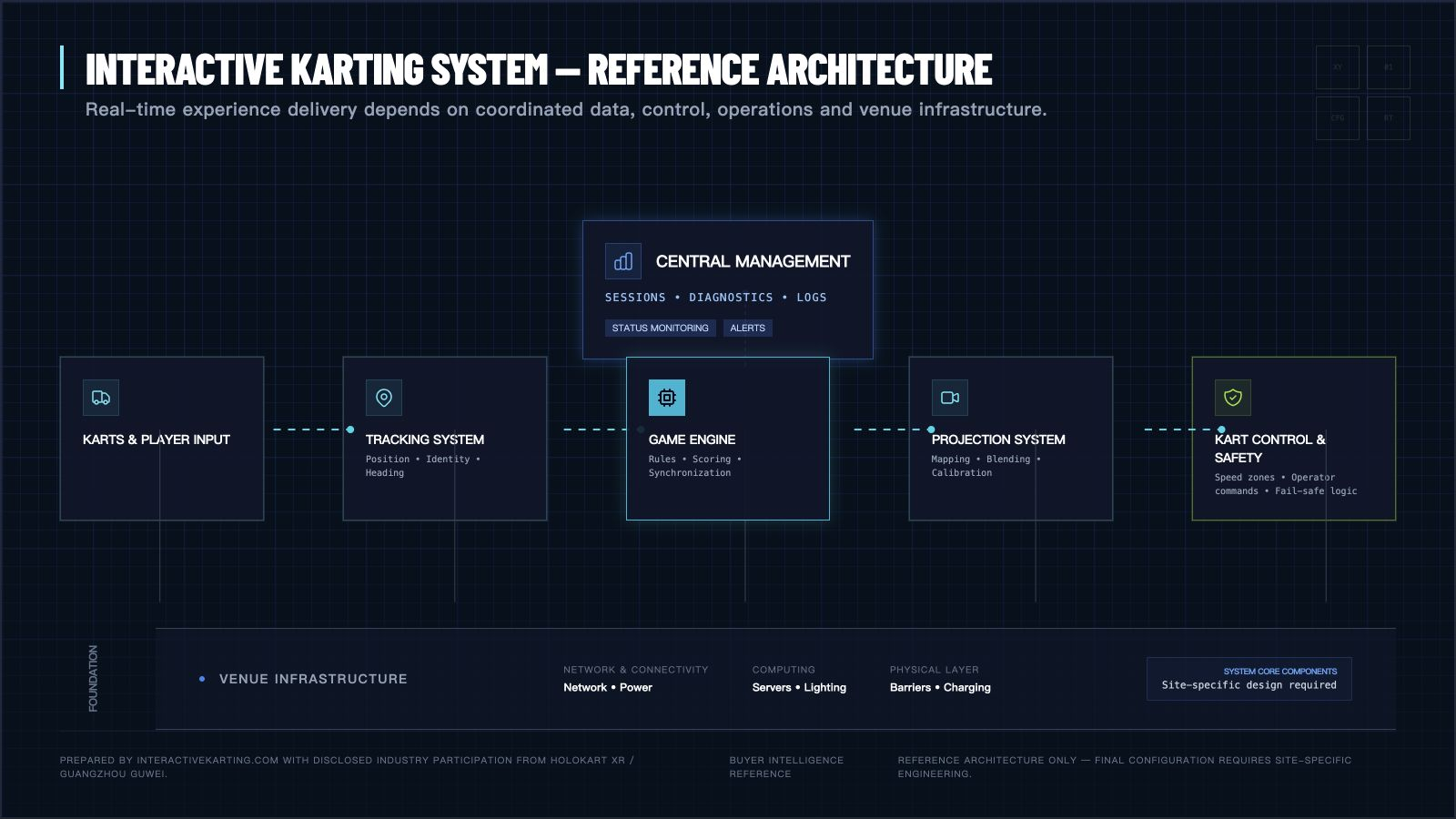
A commercial interactive karting venue is not simply a kart plus projectors. It is an integrated real-time system in which tracking, projection, game software, vehicle control, safety logic and central operations must exchange accurate data with low latency. The quality of the attraction depends on how reliably these subsystems work together during repeated public operation.
A complete architecture normally includes six layers:
- Tracking layer: detects each kart’s identity, position, heading and movement in real time, with defined coverage, refresh rate, occlusion handling and recovery behavior.
- Projection and calibration layer: maps visual content to the physical floor, blends multiple projectors, corrects geometry and maintains brightness and alignment.
- Game engine and content layer: converts tracked vehicle data into game events, scoring, power-ups, collisions, missions, timing and player feedback.
- Kart-control and safety layer: connects game or operator commands to permitted speed zones, slow/stop functions, emergency logic and vehicle status without overriding the venue’s primary safety design.
- Central management layer: handles sessions, player assignment, kart status, game selection, diagnostics, logs, operator controls and reporting.
- Venue infrastructure layer: includes track barriers, networking, power, lighting control, servers, cooling, mounting, maintenance access and operating procedures.
Reference system architecture
A useful evaluation model is: kart identity and motion → tracking server → synchronized game engine → projection output and kart-control commands → central operator console and logs. Ask the supplier to show the data flow, failure modes and ownership of each interface. A visually impressive demonstration does not by itself prove that the architecture is stable, maintainable or scalable.
1. Tracking
- What hardware and software perform tracking, and who developed them?
- What are the measured update rate, end-to-end latency and positional accuracy under venue conditions?
- How are kart IDs maintained when vehicles cross, stop closely together or enter partially occluded areas?
- What happens if tracking is lost, a sensor fails or a network packet is delayed?
- Can the supplier provide a coverage plan and commissioning acceptance test?
2. Projection and visual delivery
- Request the proposed projector count, brightness, resolution, throw ratio, lens model and mounting positions.
- Confirm overlap, edge blending, distortion correction, ambient-light assumptions and service access.
- Ask how calibration is stored, checked and restored after projector or track maintenance.
- Evaluate floor finish, image contrast and whether darker scenes remain legible during operation.
3. Game engine and software ownership
- Identify who develops the game software and who owns or licenses the source, assets and runtime.
- Ask whether rules, scoring, branding, language, maps and game modes can be modified, by whom and at what cost.
- Verify multiplayer synchronization, reconnect behavior, version control and rollback procedures.
- Request a current game list, update history and a live demonstration using the proposed number of karts.
4. Kart-control integration
- Document the interface between game events, operator commands and vehicle controllers.
- Define allowed actions, response time, fail-safe behavior, manual override and emergency-stop hierarchy.
- Confirm compatibility with the proposed kart model and whether modifications affect vehicle warranties or certifications.
- Treat speed control as one element of the safety system, never as a substitute for track engineering, barriers, supervision and local compliance.
5. Central management
- Session scheduling, player/kart assignment and operator roles.
- Real-time kart, tracking, projector, server and network status.
- Game selection, language settings, scoring, leaderboards and customer data controls.
- Fault logs, remote diagnostics, backup/restore and audit trails.
- Integration options for POS, booking, access control or venue reporting.
Buyer procurement checklist
Before requesting quotations
- Provide an accurate floor plan, clear height, columns, entrances, emergency exits and structural restrictions.
- Define target guests, session length, throughput, operating hours and expected peak demand.
- State local electrical, fire, accessibility, insurance and amusement requirements.
- Clarify whether the quotation must include track, karts, charging, projection, servers, software, installation, training and freight.
Evidence to request from every supplier
- A named bill of materials and architecture diagram for the offered configuration.
- Live or recorded operation of a comparable installed system, plus reference venues that can be contacted.
- Factory integration and burn-in test records covering tracking, projection, software and kart control together.
- Acceptance criteria for tracking coverage, game synchronization, image quality, kart commands and session recovery.
- Ownership and responsibility matrix: who manufactures, develops, integrates, installs, trains, updates and supports each subsystem.
Commercial and lifecycle questions
- Separate one-time equipment, installation, customization and recurring software/support charges.
- Define warranty start date, excluded consumables, spare-parts availability and target response times.
- Specify update frequency, remote-access method, cybersecurity responsibilities and support time zones.
- Document what happens if a third-party component or software service is discontinued.
- Include training, operating manuals, maintenance schedules, backups and escalation contacts in the contract.
FEC fit: evaluating the system as an operating attraction
For an FEC, the best technology is the configuration that can be operated safely, reset quickly and understood by guests. Evaluate the entire guest journey: check-in, briefing, helmet or restraint policy, kart assignment, loading, gameplay, scoring, unloading and turnover. Measure realistic throughput using the full cycle time, not only the advertised race duration.
- Staffing: define minimum trained roles for check-in, track control, loading and technical response.
- Downtime: ask how sessions continue if one projector, kart, tracking device or server component fails.
- Repeat play: compare game variety, difficulty settings, seasonal content and local customization.
- Accessibility: assess age, height, mobility, language, sensory and spectator needs.
- Maintainability: insist on safe access to projectors, sensors, servers, batteries and track hardware.
Acceptance testing before final payment
Attach measurable acceptance tests to the purchase contract. Run repeated sessions at the maximum agreed kart count. Test close driving, stops, crossings, restarts, network interruption, tracking loss, emergency commands, game recovery and operator handover. Record calibration baselines and confirm that trained venue staff can restore normal operation using the supplied documentation.
Red flags
- The proposal lists “interactive system” without identifying subsystem models, developers or interfaces.
- The seller cannot explain who maintains the tracking or game code.
- Only edited promotional footage is offered instead of a live technical demonstration.
- Throughput, latency, brightness or accuracy claims have no stated test conditions.
- Customization is promised without scope, delivery process, ownership or update implications.
- Safety claims rely mainly on software and do not include venue-specific engineering review.
See the system operating in a real venue
This HoloKart XR / Guangzhou Guwei supplier-published demonstration shows real electric karts operating with a projected interactive track. It illustrates the guest experience and system layers; it is not an independent performance, safety or capacity test.
Related buyer resources
- What Is Interactive Karting?
- InteractiveKarting.com Buyer Intelligence home
- Contact the editorial team or request a technical clarification
- HoloKart XR product and company information — linked for transparent relationship disclosure, not as independent validation.
Frequently asked questions
What should be included in an interactive karting system quotation?
It should identify tracking, projectors and lenses, servers, game software, kart-control interfaces, operator stations, networking, track and safety scope, installation, commissioning, training, warranty, updates, support and recurring fees.
How can a buyer compare tracking systems?
Compare coverage, update rate, end-to-end latency, accuracy, ID stability, occlusion recovery, failure behavior and performance at the proposed maximum kart count. Require tests under realistic venue conditions.
Does projector brightness alone determine image quality?
No. Image quality also depends on floor reflectance, ambient light, throw distance, lens choice, overlap, calibration, resolution, content design and maintenance.
Why does game-software ownership matter?
It determines who can fix defects, modify games, add languages or branding, supply updates and keep the venue operating if a commercial relationship changes.
Can kart speed control replace physical safety measures?
No. Integrated speed commands can support operations, but they must sit within a venue-specific safety design that includes compliant karts, barriers, track geometry, supervision, emergency procedures and local approvals.
Is InteractiveKarting.com an independent comparison site?
No. InteractiveKarting.com operates with disclosed industry participation from HoloKart XR / Guangzhou Guwei. Its checklists are intended to help buyers ask verifiable questions and should be used alongside independent engineering, legal, safety and commercial due diligence.
Interactive buyer checklist
Questions to resolve before you compare quotations
Use this condensed checklist to expose scope gaps early. Open each section, record the supplier’s evidence, and move unresolved items into the contract or acceptance plan.
1. Venue and operating brief
- Usable area, ceiling height, columns, access and evacuation constraints
- Target rider age, session length, peak throughput and staffing model
- Power, network, lighting, charging and equipment-room requirements
- Local approvals and final site engineering responsibilities
2. Complete system architecture
- Named supplier and interface for tracking, projection, game engine and kart control
- Central management, diagnostics, logging and recovery workflow
- Required servers, network equipment, sensors, projectors and spare capacity
- Ownership of integration testing and system-level performance
3. Tracking and projection acceptance
- Coverage, update rate, latency, identity handling and recovery after occlusion
- Measured calibration stability under the proposed venue conditions
- Projector brightness, overlap, mapping, service access and ambient-light assumptions
- Documented test method and pass/fail thresholds
4. Games, software and customization
- Who develops the game software and who owns source, content and updates
- Which rules, scoring, maps, branding and language elements can be changed
- Release process, rollback, backups and offline operating capability
- License term, recurring fees and end-of-life commitments
5. Kart control and safety integration
- Speed zones, remote stop, geofencing and fail-safe behavior
- Supported kart models and the party responsible for vehicle-side integration
- Manual override, fault isolation and degraded-mode operation
- Operator training, daily checks and incident records
6. Evidence, delivery and support
- Factory and integrated system tests covering all major subsystems together
- Reference sites, measured results, defect retests and acceptance sign-off
- Installation scope, milestones, exclusions, warranty and spare-parts plan
- Support owner, response targets, remote-access controls and escalation path
Need the full project checklist?
Request the extended version for supplier comparison, evidence tracking and site-specific review.
Disclosure: InteractiveKarting.com is operated with disclosed industry participation from HoloKart XR / Guangzhou Guwei. This checklist is a procurement framework—not an independent supplier ranking or a substitute for site-specific engineering.